
Praise be to Allah! What a magnificent sight it is to see spirituality harmoniously blending with the pinnacle of human intellect and technology. Today, in the heart of the Hajj season of 1447 AH (2026 AD), we are witnessing an exceptional experience by all standards. If you were to ask any pilgrim arriving from the farthest corners of the Earth about their impression, the first thing they would mention is “ease” and “fluidity.” The holy sites of Mina, Muzdalifah, and Arafat, leading to the Holy Mosque in Makkah, have become fully integrated “smart cities.” Technology here is not for show; it serves a single, sacred goal: to serve the guests of the Most Merciful and facilitate their journey of faith so they can focus entirely on worship and prayer with peace of mind. In 2026, Saudi Arabia has proven to be the leader of the Islamic world in employing technology for the service of religion and humanity.
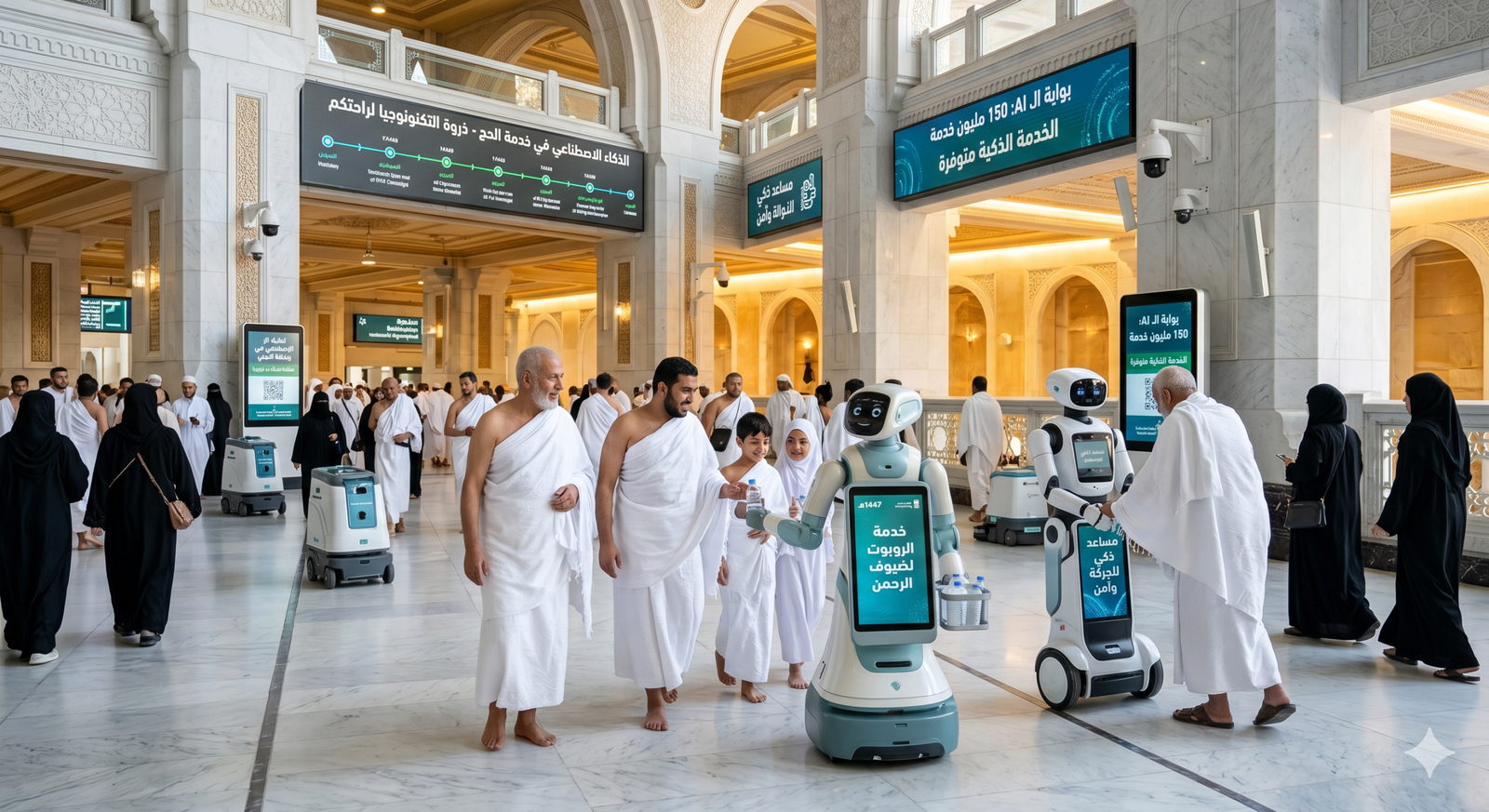
Looking at the courtyards of the Grand Mosque, we see an “army” of smart robots deployed everywhere, but these are no ordinary robots. In 2026, these robots have become capable of “understanding” and “speaking” over 50 global languages. This means a pilgrim from China, Indonesia, or Africa does not need to search for a translator. They can simply stop at the nearest guidance robot and ask in their preferred language about the Tawaf path, the direction of the Sa’i, or even the nearest health center. The robot responds politely, displaying the map on its interactive screen. This leap in generative AI has significantly reduced the burden on volunteers and security personnel, ensuring that information reaches the pilgrim in seconds without any complexity.
Beyond guidance, cleanliness and sterilization have become fully automated. Sterilization and scenting robots operate 24/7 without disturbing worshippers, utilizing advanced “UV-C” technologies to ensure a healthy, virus-free environment—a standard that has become fundamental in modern Hajj. If you get thirsty in the crowd, worry not; “Zamzam Water” robots roam through the ranks, distributing cold water bottles with utmost courtesy, knowing exactly when to stop and move thanks to advanced sensors that prevent any collisions. All of this is coordinated from a “Smart Operations Room” managed by highly skilled young Saudi men and women who monitor the robots’ movements and ensure everything proceeds according to plan.
In the “Arafat Plain,” the situation feels like something out of a dream. The upgraded tents in 2026 are all “smart tents” linked to a central system for climate control and air quality. The electronic bracelet worn by every pilgrim has become their “identity,” “medical file,” and “digital wallet.” If a pilgrim falls ill—God forbid—anywhere, the system sends an immediate alert to the nearest paramedic team, pinpointing their location with “centimeter-level” accuracy and providing the medical staff with a full report on their condition and medical history before they even arrive. This is the AI that saves lives and accelerates response times during critical moments.
What is truly impressive is the “Crowd Management” system of 2026. Thermal cameras and AI analyze crowd density at the “Jamarat Bridge” and the Tawaf area. Based on this data, pilgrims are directed via the enhanced “Nusuk” app to alternative paths that are less crowded. This system has made the phenomenon of “stampedes” a thing of the past, turning Hajj into a safe and organized journey where each pilgrim feels they have their own private path, despite the millions around them. Saudi Arabia has indeed invested billions of Riyals in digital infrastructure, and the result today is seen in the “tears of joy” and comfort in the eyes of the pilgrims as they complete their rituals with ease.
Are these robots available in all the holy sites or just in the Grand Mosque? By 2026, robots and smart services cover all the holy sites without exception. From the moment a pilgrim arrives at the airport and is greeted by a procedure-completion robot, to the sites of Mina, Arafat, and Muzdalifah. The coverage is comprehensive, ensuring that the digital experience is connected and uninterrupted throughout the Hajj period.
How can elderly people who are not tech-savvy deal with these devices? This point was one of the Ministry of Hajj’s top priorities. The robots and smart systems in 2026 are designed with very simple interfaces and rely primarily on “voice commands.” A pilgrim does not need to press buttons; they simply speak to the robot or the voice device in their tent, and the system understands and responds. Furthermore, trained human teams are always present to intervene and provide assistance if necessary.
At the conclusion of this blessed season, we can say with pride that the Kingdom of Saudi Arabia has presented the world with the “Smart Hajj” model, which combines the sanctity of the place with the advancement of the era. The success of the 1447H Hajj season is a success for every Muslim and a clear message that we are committed to enhancing the journey of the guests of the Most Merciful year after year. Technology in Hajj has become a means to a higher end: ensuring that the pilgrim returns to their country carrying nothing but beautiful memories and a facilitated journey of faith. We thank Allah for this completion, and may our country continue to prosper under our leadership, which spares no effort in serving His Holy House and its honored guests.