
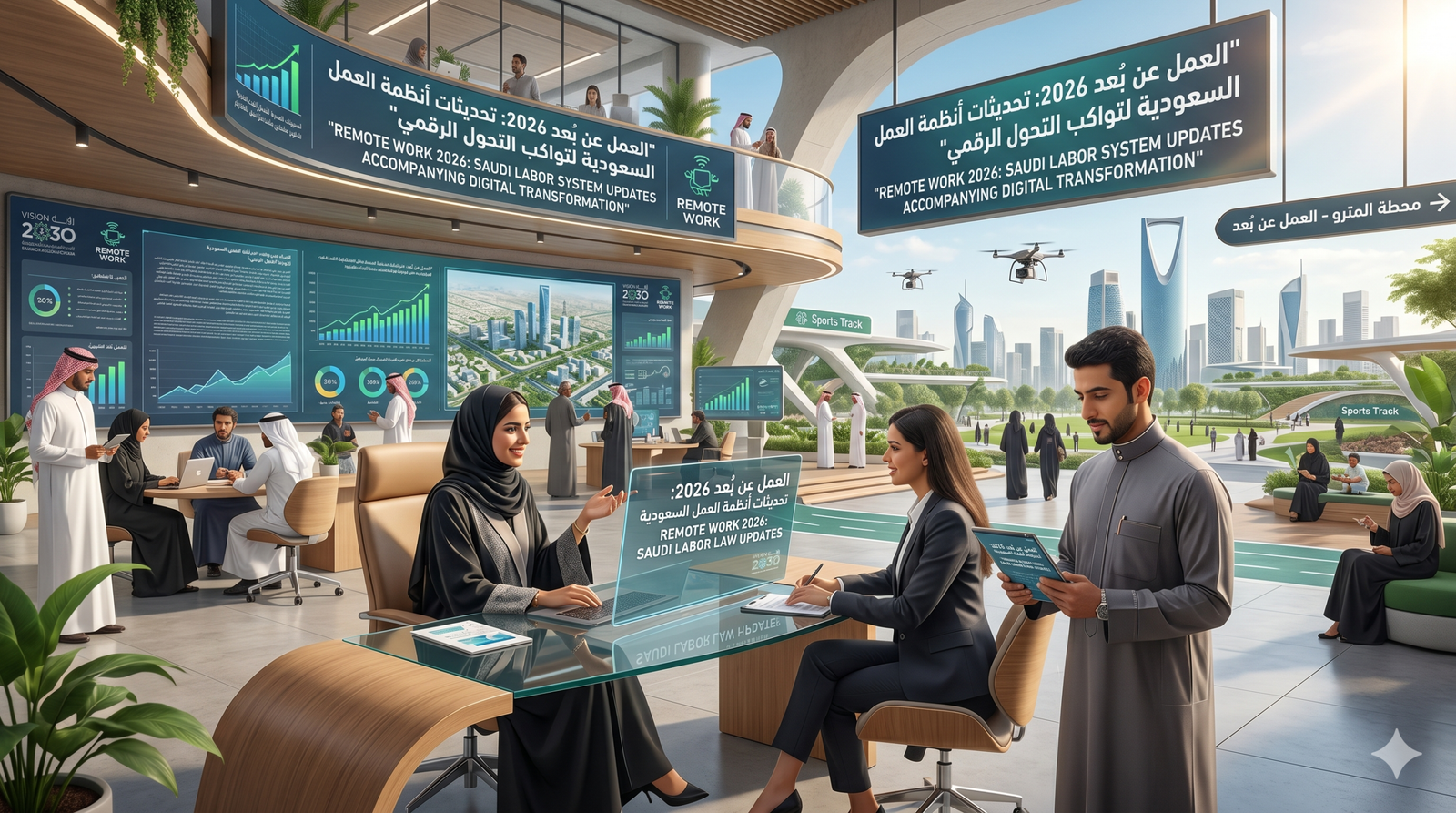
Greetings to everyone reading this, whether you are sitting in your offices or sipping your coffee while working from home! Remember the days of “fingerprint attendance” and the strict 8-to-4 grind? In 2026, that image has become a part of the past for our children, and “flexibility” has become the magic word in the Saudi labor market. Today, the Ministry of Human Resources and Social Development announced the largest package of updates to the labor system to keep pace with the digital revolution we are experiencing. Saudi Arabia in 2026 is no longer just building towers and factories; it is building a “work environment” that is among the most advanced and flexible in the world. Imagine being able to live in “Abha,” amidst the clouds and cool weather, while working for a company headquartered in “Riyadh” with a seamless system that protects your rights. Today, we discuss how “Remote Work” in 2026 has become the new engine of the Saudi economy and how it has changed the lives of millions for the better.
The updates we saw in 2026 are not just mere “article amendments”; they are a total redefinition of the concept of a job. The new system now recognizes “Flexible Work” and “Remote Work” as primary patterns, not just exceptions. Now, there is a “Unified Digital Employment Contract” that guarantees the employee’s right to medical insurance, social insurance, and defined working hours, even if they are working from Mars! What truly warms the heart in 2026 is the “Right to Digital Disconnect”; meaning the employee has the right not to respond to work emails or calls after their official working hours. This update came to preserve “Mental Health” and the work-life balance, a feature that has made Saudi companies top the global “Best Places to Work” lists.
Artificial Intelligence in 2026 has become the “Logistical Manager” for remote work. The enhanced “Qiwa” platform now provides smart tools that measure employee productivity based on “outputs” rather than “sitting hours.” This shift has allowed Saudi companies in 2026 to save billions of Riyals that used to go into massive office rents and electricity bills, investing those amounts instead in developing their employees’ skills. The beauty is that this system has opened doors of opportunity for our daughters and sons in remote areas; now, a creative individual in “Jazan” or “Tabuk” can work for the largest banks in Riyadh without worrying about relocation or housing costs—this is what we call “Developmental Justice” achieved by Vision 2030 in 2026.
The biggest surprise in 2026, however, was the launch of the “Digital Nomad Visa” for global talent. Saudi Arabia has become the world’s premier destination for programmers, designers, and creators who want to work in an advanced environment like “NEOM” or “AlUla” while performing their jobs for companies in the US or Europe. This global presence of talent on our soil has led to an extraordinary “Knowledge Transfer” for our youth, and Riyadh in 2026 has become a “giant cafe” gathering the world’s smartest minds. The new regulations organized all these processes clearly, and the Saudi economy is benefiting from these minds who live, spend, and invest here, enhancing the Kingdom’s position as a global technical gravity center.
We must also not forget the role of “Infrastructure”; in 2026, with 5G and 6G coverage in every inch of the Kingdom, “disconnection” is a word erased from our dictionary. Virtual meetings are now held via “Hologram” technologies that make you feel like your manager and colleagues are sitting in the room with you, breaking the barrier of isolation that some used to suffer from in remote work in the past. Saudi Arabia in 2026 proved that it is a nation ahead of its time and that our labor system now protects the “human” and stimulates “creativity.” Today, we don’t work just to finish hours; we work to achieve accomplishments, and the nation has provided us with all the means to innovate from anywhere under any sky.
Q1: Does a remote employee in 2026 have the same rights as an on-site employee regarding bonuses and promotions? Under the latest updates in 2026, the law strictly prohibits any discrimination between remote and on-site employees. Promotions, bonuses, and training are now based on “Digital Key Performance Indicators” (KPIs) that measure actual achievement. In fact, many companies now prefer committed remote employees because they have proven higher productivity and greater focus.
Q2: How are workplace injuries handled for an employee working from home in 2026? This is one of the smartest updates; the 2026 labor law expanded the concept of “Workplace Injury” to include accidents that occur while performing job duties at the “Agreed-upon Location” (whether it is a home or a co-working space). An employee registered on the official “Remote Work” platform receives full care and compensation from social insurance, as long as they adhere to the digital occupational safety standards defined by the Ministry.
In concluding our tour of the world of flexible work for 2026, we can say that the “Office” has become the place where you are comfortable and creative, not necessarily a building with walls. Saudi Arabia today has provided a global model for how to develop laws to suit the ambitions of the “iPad” and AI generation. Remote work in 2026 is a story of responsible freedom and the success story of a nation that knew how to harness technology to serve its citizens. Prosperity to our Kingdom, and long live our young men and women who prove every day that they are “capable” and worthy of trust from wherever they work. The promise is in the achievement, and the promise is at the summit!