
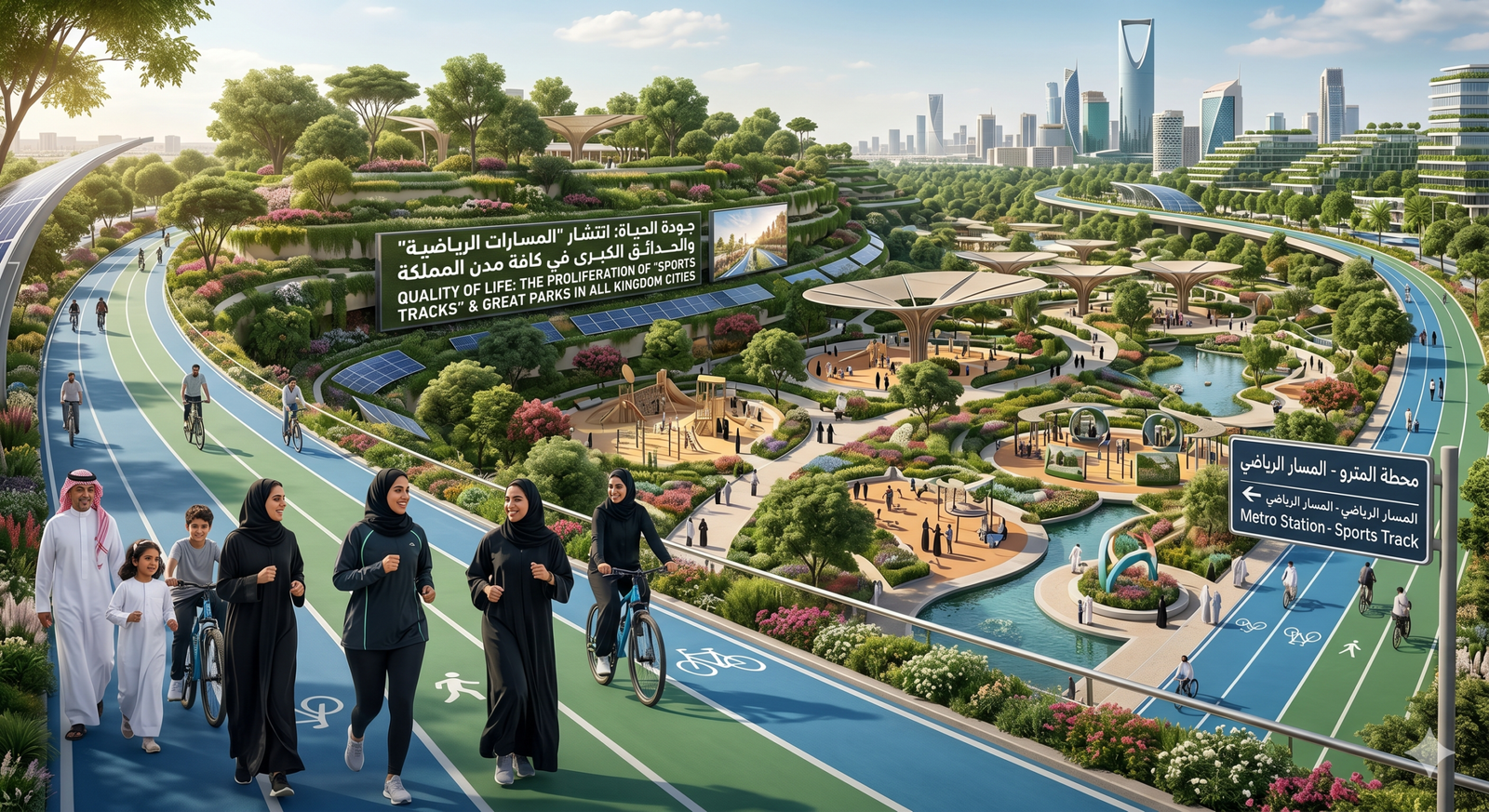
Greetings to all lovers of walking, fresh air, and beautiful gatherings in green spaces! If we look back to 2018 or 2019, the idea of walking on a world-class “promenade” or sitting in a park with global specifications in the heart of Riyadh or Jeddah during the height of summer was considered somewhat difficult. However, today, in the middle of 2026, the tables have completely turned. Saudi Arabia has become a smart “green forest,” and our cities have transformed from concrete jungles into “human-centered” cities. The Quality of Life Program, one of the key pillars of Vision 2030, has brought us a new reality in 2026; sports tracks now connect our neighborhoods, and major parks have become the “lungs” we breathe through. Today, we discuss how Riyadh, Jeddah, Dammam, and all our cities have become global destinations for healthy living and prosperity, and how we take pride in the “lifestyle” of our country.
A discussion in 2026 cannot begin without mentioning the “Sports Boulevard” in Riyadh. This project, extending over 135 kilometers, has become a global landmark connecting the east of the capital to its west, from Hanifa Valley to Al Sulai Valley. Imagine being able to ride your bicycle and traverse the entire city of Riyadh on dedicated, safe tracks surrounded by trees and cooling fountains. What is truly dazzling in 2026 is the “Global Sports Tower,” which has reached towering heights and houses the world’s tallest indoor climbing wall. The Sports Boulevard is not just for professionals; it’s for all families. It features pedestrian pathways, horse trails, and artistic zones showcasing Saudi and international sculptures. Living near the Sports Boulevard in 2026 has become a dream for every resident because it has simply elevated Riyadh to the level of cities like London and New York in terms of urban quality of life.
As for “Green Riyadh” in 2026, the numbers are astronomical! The Ministry of Municipal, Rural Affairs and Housing, in cooperation with the Royal Commission for Riyadh City, has successfully planted millions of trees. The major “Al-Uruba” Park, whose main phases opened in 2026, has become the premier destination for families, with its area exceeding one million square meters and its panoramic track that allows you to see the capital from above the greenery. The beautiful thing is that these parks use 100% treated water for irrigation—a testament to Saudi environmental intelligence. In 2026, there is no neighborhood in Riyadh without a park within a few minutes’ walk from your home. This has significantly increased the per capita share of green space and reduced the summer temperature by 2 to 3 degrees Celsius.
Beyond the capital, in 2026, Jeddah has become the “Bride of the Green Sea.” The “Jeddah Central Park” project and the development of the waterfronts have turned walking on the Corniche into a comprehensive sporting experience with long tracks for running and cycling. In the Eastern Province, oases and major parks have transformed into tourism and sports magnets. The target set in the Vision to raise the rate of sports participation to 40% among the population was surpassed in 2026 thanks to the availability of these facilities. Now, it is common to see people in all cities out practicing sports after work, not just because it’s beneficial, but because the “environment is inviting” and encourages movement.
The social and economic impact in 2026 of this transformation is astounding. Public health has improved, and the levels of happiness and satisfaction among citizens and residents have reached record numbers in global quality of life indices. Real estate overlooking these tracks and parks has become the most in-demand, opening the way for thousands of small businesses such as healthy cafes, bicycle rental shops, and sports event organizers. Saudi Arabia in 2026 has proven to the world that “humanizing cities” is the true key to building a vibrant and strong society. Today, we aren’t just building a “walkway” or a “park”; we are building a “culture of life” that makes every day in the Kingdom a journey toward health and beauty.
What distinguishes the “Sports Boulevard” in Riyadh from any other walkway in the world? In 2026, the Sports Boulevard is distinguished as the “world’s largest linear park,” extending for 135 km in a completely continuous manner without intersections that hinder movement. It also features the global “Sports Tower” and dedicated areas for 50 different sports, in addition to integrating arts and culture into the track, making it a tourism, sports, and economic destination all at once, rather than just a walking path.
How have afforestation projects like “Green Riyadh” contributed to changing our cities’ climate in 2026? Afforestation projects in 2026 successfully lowered the ambient temperatures around buildings and roads thanks to “natural shade” and increased humidity. They have also improved air quality by absorbing carbon and reducing dust, which has allowed people to enjoy open spaces for longer periods even during summer days, enhancing the concept of sustainable living.
In concluding our journey among the green tracks and major parks of 2026, we can say that the quality of life in Saudi Arabia has become the “gold standard” in the region. Our cities today smile at their residents and invite them to move and enjoy every corner. The achievements we see today are the fruit of an ambitious vision that decided the Saudi individual deserves to live in the best possible environment. Prosperity to our green Kingdom, and long live the nation that plants happiness and health in every inch of its land. See you at the park, see you at the track, where life has a different and more beautiful taste!