
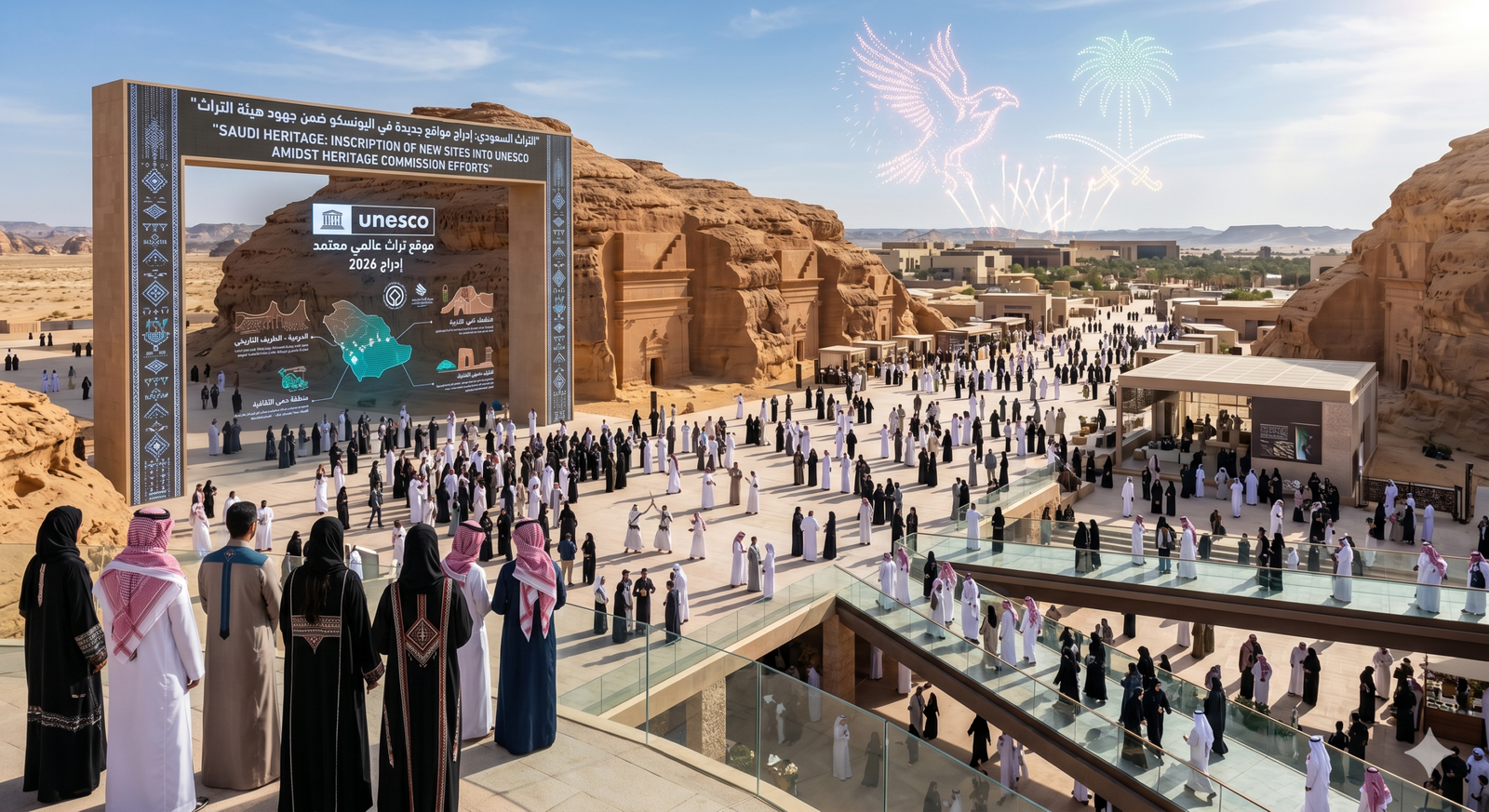
Introduction: Welcome to all history buffs and those seeking the scent of the past in the breath of the present! If we look back ten years, we only had one or two sites listed on the UNESCO World Heritage list, and we were incredibly proud of them. But today, in the heart of 2026, Saudi Arabia has become a “global open-air museum” in every sense of the word. The news topping the headlines today is UNESCO’s announcement of adding new Saudi sites to the World Heritage List. This achievement didn’t come from a vacuum; it is the fruit of the monumental efforts of the Saudi Heritage Commission, led by our creative national cadres. Today, we’re talking about these new sites, why the world is fascinated by our heritage, and how we managed to preserve our identity and make it a global “trend” that attracts tourists and researchers from everywhere.
The Article: In 2026, the Saudi list in UNESCO includes sites that tell the story of humanity over thousands of years. The sites added today include the “Al-Faw Archaeological Area” in Wadi ad-Dawasir, the first capital of the Kindah Kingdom, and the “Rijal Almaa” heritage village in Asir, with its unique architecture that resembles hanging palaces. By 2026, the Heritage Commission moved beyond traditional restoration, utilizing “Digital Twin” technologies and Artificial Intelligence to document every stone and inscription with utmost precision. Tourists visiting these sites today can wear Augmented Reality (AR) glasses to see what life was like in Al-Faw 2,000 years ago—a stunning fusion of heritage and the future that defines Vision 2030.
Speaking of “Al-Faw,” by 2026, it has become a global destination for archaeologists. Recent discoveries announced by the Commission revealed temples, markets, and highly advanced irrigation systems, proving that our ancestors were pioneers in trade and agriculture in the heart of the Arabian Peninsula. Visitors don’t just see stones; they see a “story of struggle” and the ability to adapt to the desert environment. In “Rijal Almaa,” the atmosphere is completely different; there, the scent of rain mixes with the smell of mud and stone. The Commission successfully rehabilitated the village into a tourist destination featuring boutique hotels managed by local families—an investment in “Living Heritage” that makes the community a partner in preserving its history.
Efforts in 2026 also extended to the “Rock Art” in the Hail and Najran regions, considered the world’s largest open library. The Heritage Commission launched the digital “National Inscriptions Registry,” which has led researchers from global universities like Harvard and Oxford to race to study these inscriptions that narrate early human migrations. Saudi Arabia in 2026 proved that it doesn’t just possess oil and energy; it possesses “civilizational depth” spanning thousands of years. This international recognition from UNESCO is a testament that we are preserving the heritage of humanity, not just our own, and that we are ready to share these treasures with all the world’s inhabitants with authentic Saudi “Hafawah” (hospitality) and generosity.
The economic impact of this achievement in 2026 is unparalleled. Listing new sites means an increase in tourist flows, opening new airports and tourist routes, and creating thousands of jobs in the archaeology and heritage tourism sectors. Saudi handicrafts, which were once threatened with extinction, have become luxury brands sold in international airports by 2026, with each piece telling the story of a Saudi UNESCO site. In 2026, we are not just restoring buildings; we are restoring a “national memory” and presenting it to the world in its most beautiful form. Every site added to UNESCO is a new brick in the wall of our soft power and a clear message that Saudi Arabia has been a “crossroads of civilizations” from ancient times to eternity.
FAQs:
-
Q1: How does UNESCO choose Saudi sites, and is the process difficult?
-
By 2026, the process has become very precise. The Heritage Commission submits a comprehensive file proving the “Outstanding Universal Value” of the site. The file must include a protection and restoration plan, historical research, and an environmental impact study. UNESCO sends experts to the site to verify every detail. Thanks to the professionalism of Saudi teams in 2026, our files are accepted with high regard because they adhere to the highest international standards.
-
-
Q2: Are the new UNESCO sites open to visitors, and how can we reach them?
-
Absolutely! All sites listed by 2026 are equipped to receive visitors with world-class visitor centers, walking trails, and tour guide services. You can book your visit via the unified “Turathuna” app. Direct flights are available to airports near these sites (such as AlUla, Abha, and Sharurah), with smart infrastructure and roads facilitating access to the heart of Saudi history.
-
Conclusion: In concluding our journey among our archaeological treasures of 2026, we can say that we have successfully reconciled the past with the future. Listing new sites in UNESCO is a source of pride for every Saudi man and woman, and it is our promise to the world that we will remain the faithful guardians of our ancient heritage. Our heritage is not just silent stones; it is our identity that distinguishes us and the bridge that connects us with all the peoples of the Earth. Prosperity to our Kingdom, and prosperity to the Heritage Commission, which has made the whole world sing the name of Saudi Arabia and its glorious history. See you at the archaeological sites, where time and place have a different flavor!